Orange streaks running down the stucco just below the top of a chimney are one of the most common reasons owners in La Puente get in touch with us. On a house with a factory-built fireplace, those streaks almost always come from one sheet of metal: the chase cover. This post covers what that part does, how it fails, what replacing it involves, and where the cap above it fits into the price.
The box on your roof is not a chimney
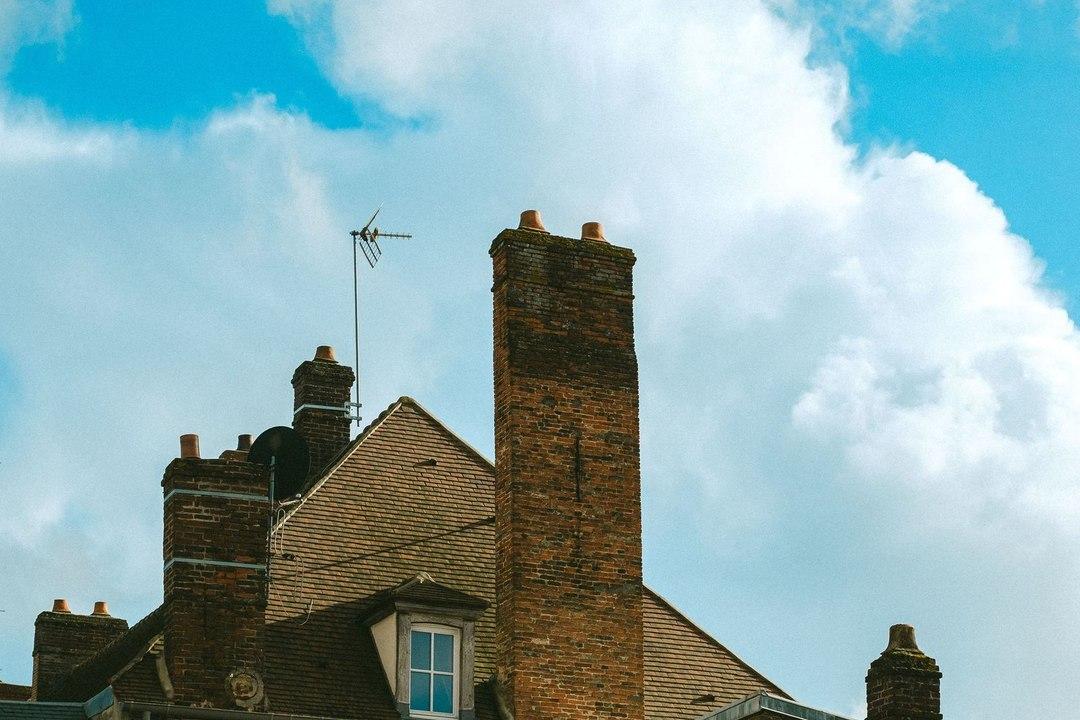
On a masonry house, the chimney is brick or block all the way up. On a house with a prefab fireplace, the actual chimney is a metal pipe, and the thing you see on the roof is a wood-framed box built around it. Builders across the San Gabriel Valley finished those boxes in stucco to match the walls, or in siding on some later houses.
The top of that box has to be closed off, and the pipe has to pass through it. That closure is the chase cover, sometimes called a chase top or chase pan. A storm collar seals the gap where the pipe comes through, and the listed cap sits on the pipe above.
If the chase cover leaks, the water does not land on brick that can shrug it off. It lands on plywood, framing lumber and insulation, and eventually on the top of the steel firebox below.
How chase covers fail
Most original covers were plain galvanised steel. In our climate, with dry summers and hard winter storms, the zinc coating wears through in time and the steel underneath rusts. Three patterns turn up again and again:
- Dishing. The flat top sags in the middle and holds a puddle after every storm. Standing water finds the nail holes and the seams.
- Rust-through. Pinholes, then larger holes, usually around the pipe collar where water sits longest.
- Lifted edges. Santa Ana winds work loose fasteners until a corner lifts and rattles. Wind-driven rain then goes straight under it.
From the ground you may see rust streaks, a cover that looks wavy, or a cap leaning to one side. Inside, the signs are a water stain on the ceiling near the fireplace wall, rust flakes on the hearth, or a musty smell when the damper is open.
What a replacement looks like
A new chase cover is made to the measured top of your chase. We use stainless or coated steel, formed with a raised centre or cross-break so water runs to the edges instead of pooling. The edges fold down over the outside of the box far enough to shed rain past the stucco line, and the hole for the pipe gets a raised collar so water cannot run into the opening.
On the day, we take off the cap and storm collar, lift the old cover, and look at the wood underneath. If the top plates of the framing are soft, we tell you before we close anything up. The new cover goes on with sealed fasteners, the storm collar is refitted and sealed to the pipe, and the listed cap goes back on top, or a new one if the old one is past saving.
Our chase cover page lists everything that visit includes.
The cap is part of the same job
On a metal chimney, the cap is not a generic accessory. It belongs to the pipe maker's listing and is part of how the pipe vents and keeps itself cool. A rusted, bent or missing cap is replaced with the cap made for that pipe, never a masonry cap clamped on.
A chimney cap is quoted after we measure on this site. The price varies because the job is: a stock listed cap on a common pipe sits near the bottom, a hard-to-source termination for a discontinued model costs more, and a decorative shroud over a large chase sits the biggest. Our cap installation page shows the types we fit.
What decides the cost
There is no single published price for a chase cover, because every chase is a different size and every roof a different climb. The number in your written quote depends on:
1. The measured size of the chase top, and whether it is square or a long rectangle. 2. Stainless or coated steel, and the gauge of the metal. 3. Whether the cap and storm collar can go back on or need replacing. 4. What the framing looks like under the old cover. 5. Roof access: a low single-storey ranch versus a steep two-storey.
If there is rust on your stucco, a wavy top or a leaning cap, describe what you see from the yard in the quote form and tell us roughly how wide the chimney box looks against the roofline. We reply with a visit to measure and a written price.
When water has already got in
If the cover has been leaking for a few winters, the cover alone will not finish the job. Wet framing may need drying or replacing, the top of the firebox may have rust, and the stucco may have cracked where the wood swelled. In those cases the work falls under leak repair, which runs $590 to $3,550 depending on how many sources there are and how far the water travelled. Our post on leaks around a framed chase walks through how we trace them.
Why we do not just paint the old one
Coating a rusted cover buys a season at most. The paint seals the surface, but the steel underneath keeps thinning, and a dished top still holds water. We will tell you if your cover is young enough that a coating makes sense, but on most houses in La Puente old enough to show rust streaks, replacement is the repair that lasts.
Getting the chase top looked at in La Puente
We measure and replace chase covers on houses across La Puente, West Covina, Covina and Diamond Bar. When you are ready to have yours measured, the contact page is the quickest route to us.
Want a Look at Your Own Unit?
Hurley Chimney Works works from La Puente across West Covina, Covina, Diamond Bar and nearby cities. We read the label, check the parts against the listing and leave photos with a price for each repair.